

Estimated reading time: 9 minutes
Picture this. It’s 2015, and suddenly the yellow packets that lived in every Indian kitchen are gone.
Not sold out. Not temporarily unavailable. Banned.
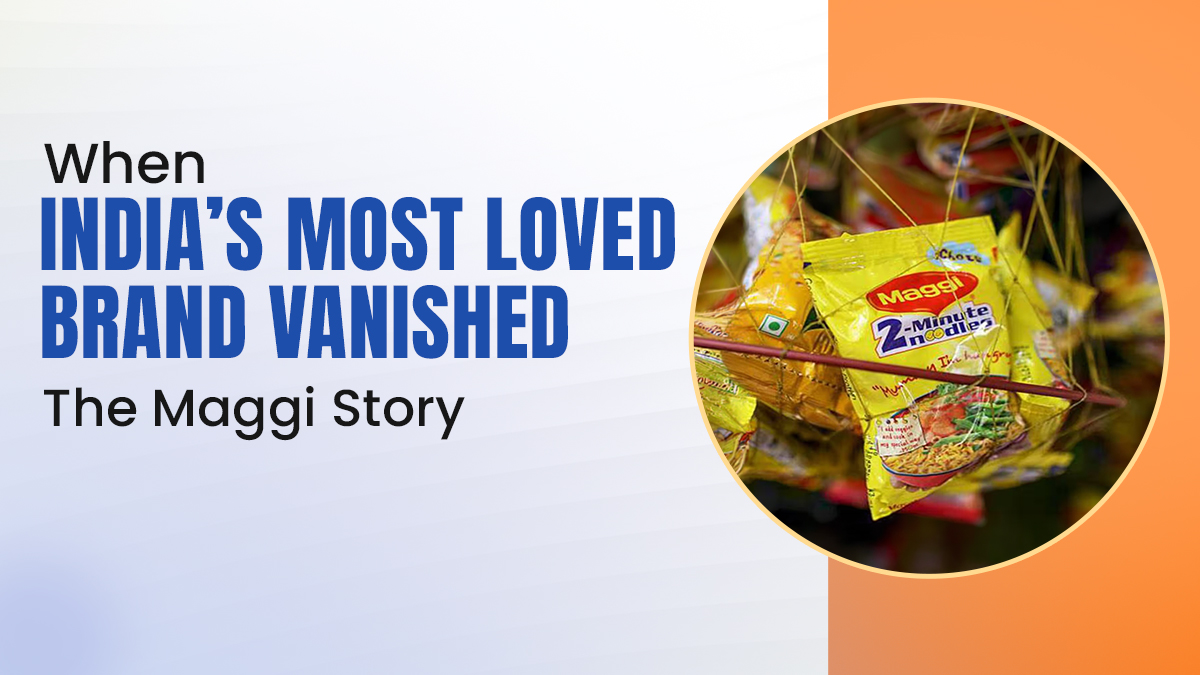
Maggi, the answer to midnight hunger, hostel survival, and “Mom, I’m hungry,” had disappeared from shelves across the country. Lead contamination, the headlines screamed. Unsafe for children, the reports declared. A thirty-year love story between India and its favourite two-minute meal seemed to have ended overnight.
For most brands this would have been the final chapter. Maggi turned its biggest failure into one of the most remarkable comebacks in Indian business history.
What Actually Happened in June 2015 When Maggi Disappeared Overnight?
June 2015 hit Nestlé India like a freight train nobody saw coming.
One day Maggi was selling millions of packets. The next, news channels couldn’t stop talking about excessive lead levels and MSG. Parents who grew up eating Maggi themselves were throwing away unopened packets. Social media turned into a courtroom. The government stepped in and the ban was official.
- Decades of trust and memories were questioned in a matter of days
- Zero revenue. Zero presence. And worse than both, zero trust
- When your reputation crumbles you can’t buy your way back, advertise your way out, or hide and hope people forget
Maggi understood this. Instead of spinning the narrative or minimising the damage they made a decision that seemed almost crazy at the time. They chose to start over.
The Maggi Comeback Framework
| Pillar | What It Involved | Evidence |
| 1. Safety First, Sales Second | Reformulated the product, removed every ingredient that could raise eyebrows, set testing protocols stricter than regulators demanded | Brought in independent labs to verify everything instead of just passing the minimum required tests |
| 2. Make the Fix Visible | Documented the entire process publicly, opened factories to skeptics, answered questions they weren’t required to answer | Safety stopped being a behind-the-scenes fix and became their new identity |
| 3. Acknowledge the Feeling Before Selling | Launched “Miss You Maggi” instead of “We’re Back and Better” | Gave space to a longing millions of Indians already felt. Families were the heroes, Maggi just wanted to be invited home |
| 4. Win on Execution Not Just Message | State-by-state relaunch, rebuilt distributor relationships, trained retailers to answer concerns | Strategy got the headlines. Operations got the results |
How Did Maggi Rebuild Trust Instead of Just Trying to Restore Sales?
Most companies in crisis do the minimum required to survive. Pass the tests. Issue an apology. Launch a discount campaign. Move on.
Maggi did none of that. They tore everything apart and rebuilt it with one non-negotiable principle: safety first, sales second.
They reformulated the entire product. Created testing protocols stricter than regulators demanded. Then they documented the whole thing publicly. Every change, every test result, every safety measure. They turned their factories into open books and invited skeptics to visit.
- When something goes wrong most of us want to fix it quietly and hope nobody noticed
- Maggi did the opposite. They made their transformation visible, tangible, and verifiable
- Safety became their identity, not just a fix
For founders: when trust breaks, the repair has to be something people can actually see. Quiet fixes don’t rebuild public confidence.
Why Did a Campaign Called “Miss You Maggi” Work Better Than a Loud Comeback?
After months of hard work the temptation was obvious. Come back with guns blazing. “Maggi 2.0, now even safer.” Celebrity endorsements. Flashy packaging.
Instead they launched a campaign called “Miss You Maggi.”
Not “Trust Us Again.” Not “We Fixed Everything.” Just: miss you.
Millions of Indians genuinely did miss Maggi. The void in their kitchens was real. The memories didn’t disappear just because the product did.
- By acknowledging that longing instead of talking about themselves, Maggi created a genuine conversation
- Nutritionists and food experts joined digital conversations to answer hard questions honestly, not to praise Maggi
- Influencers were invited into factories with one message: ask us anything
This wasn’t a marketing campaign. It was an apology backed by genuine change.
For founders: the best comeback message isn’t about you. It’s about the people who miss you.
What Boring Operational Work Made the Comeback Actually Stick?
While the emotional ads were running a massive overhaul was happening behind the scenes.
Maggi couldn’t just show up in stores and hope for the best. They did a careful state-by-state relaunch, waiting for clearance in each region. They rebuilt relationships with distributors who’d been burned during the ban. They trained every retailer to answer customer concerns with confidence.
They also noticed the market had moved. Health-conscious consumers wanted more options and competitors had filled shelves with wellness variants. So Maggi didn’t just bring back classic masala. They introduced oats noodles, atta variants, and breakfast options. They signalled evolution, not just return.
- Strategy gets you headlines. Execution gets you results
- Most founders spend 80% of their energy on the message and 20% on the mechanics. Maggi flipped that ratio
- Full recovery took over two years of relentless, consistent work with no shortcuts
For founders: the perfect repositioning means nothing if distribution is shaky or quality is inconsistent.
Maggi’s Comeback vs. The Typical Crisis Response Playbook
| Dimension | Maggi’s Approach | Typical Crisis Response | Long-Term Outcome |
| Fixing the problem | Rebuilt the product from scratch with stricter standards than required | Passed minimum regulatory tests and moved on | Genuine trust vs. fragile compliance |
| Transparency | Opened factories and documented every change publicly | Fixed things quietly and hoped nobody noticed | Verifiable proof vs. empty reassurance |
| Messaging | Led with “Miss You Maggi,” acknowledging customer feelings first | Led with discounts and “we’re back” announcements | Emotional connection vs. transactional apology |
| Execution | Careful state-by-state relaunch with distributors and retailers aligned | Rushed national relaunch chasing lost revenue | Stable recovery vs. shaky return |
| Evolution | Added oats, atta, and breakfast variants to meet new demand | Returned with the exact same product | Emerged stronger vs. recovered to where they were |
FAQ
Ques1: Why did Maggi choose to rebuild the entire product instead of just passing the regulatory tests?
Ans1: Because passing a test doesn’t rebuild trust. Maggi understood that millions of families needed to believe again, and belief doesn’t come from minimum compliance. By reformulating the product and setting testing standards stricter than regulators required, Maggi gave people a real reason to trust the packet again rather than just a certificate saying it was allowed back on shelves.
Ques2: Why did making the process public matter so much for Maggi’s recovery?
Ans2: Because trust that’s been broken can’t be repaired by asking people to just take your word for it. Opening factories, sharing test results, and answering questions they weren’t required to answer let skeptics verify the change themselves. That visibility turned safety from a claim into proof, which is the only thing that actually rebuilds confidence after a crisis.
Ques3: What made “Miss You Maggi” such an effective comeback campaign?
Ans3: It started with the customer’s feelings instead of Maggi’s own story. Millions of Indians genuinely missed the product, and the campaign gave that feeling a voice instead of trying to talk over it. Families became the heroes of the story and Maggi simply asked to be invited back home, which felt honest in a way a loud “we’re back” announcement never could.
Ques4: Why did Maggi’s relaunch happen state by state instead of all at once?
Ans4: Because rebuilding trust requires getting every layer right, not just the consumer message. Waiting for clearance in each region, rebuilding distributor relationships, and training retailers to answer customer concerns meant the product was actually supported when it returned. A rushed national launch would have risked a second failure at exactly the moment Maggi couldn’t afford one.
Ques5: What is the single most important lesson from Maggi’s comeback for founders facing their own crisis?
Ans5: Don’t just ask how to avoid failure. Ask what you’ll do when failure finds you anyway. Maggi took the longer, harder path of admitting the problem, rebuilding honestly, and making the fix visible. That path takes more than two years and offers no shortcuts, but it’s the only one that produces trust worth keeping.
Summary
June 2015. Yellow packets vanishing from every shelf in the country. A thirty-year relationship with millions of Indian families suddenly in question.
Most brands would have treated that as the end. Maggi treated it as the moment to find out what they were actually made of.
They didn’t spin it. They didn’t hide. They rebuilt the product from scratch with standards stricter than anyone required, then opened their factories so skeptics could see the change with their own eyes. They came back with “Miss You Maggi” instead of a victory lap, because the families who’d missed them mattered more than the brand’s own comeback story. They relaunched state by state, rebuilt distributor relationships, and evolved the range for a market that had moved on without them.
Every founder hits a moment when everything feels like it’s collapsing. A launch that flops. A viral criticism. A sudden regulation that threatens the entire model. In those moments there are two paths. One is quick fixes and surface changes that rarely work past the next quarter. The other is longer, harder, and requires admitting mistakes and rebuilding honestly.
Maggi took the second path.
Today it isn’t just back on shelves. It’s proof that broken trust can be rebuilt if you’re willing to do the work, and a reminder that the most powerful brands aren’t the ones that never stumbled. They’re the ones that stumbled publicly, rebuilt honestly, and came back better.
Maggi isn’t really selling noodles anymore. It’s selling a promise kept.
At Believers Destination, we help founders build brands that can weather storms, win back trust, and turn setbacks into strategic advantages. Great brands aren’t defined by never failing. They’re defined by how they rise.
