

Estimated reading time: 5 minutes
There’s an unwritten rule every founder and marketer operates by: you find a problem and you solve it.
Dusty house? Better vacuum. Late-night cravings? Food delivery. Stained clothes? Stronger detergent.
Clean, simple, and logical. That’s how it always worked.
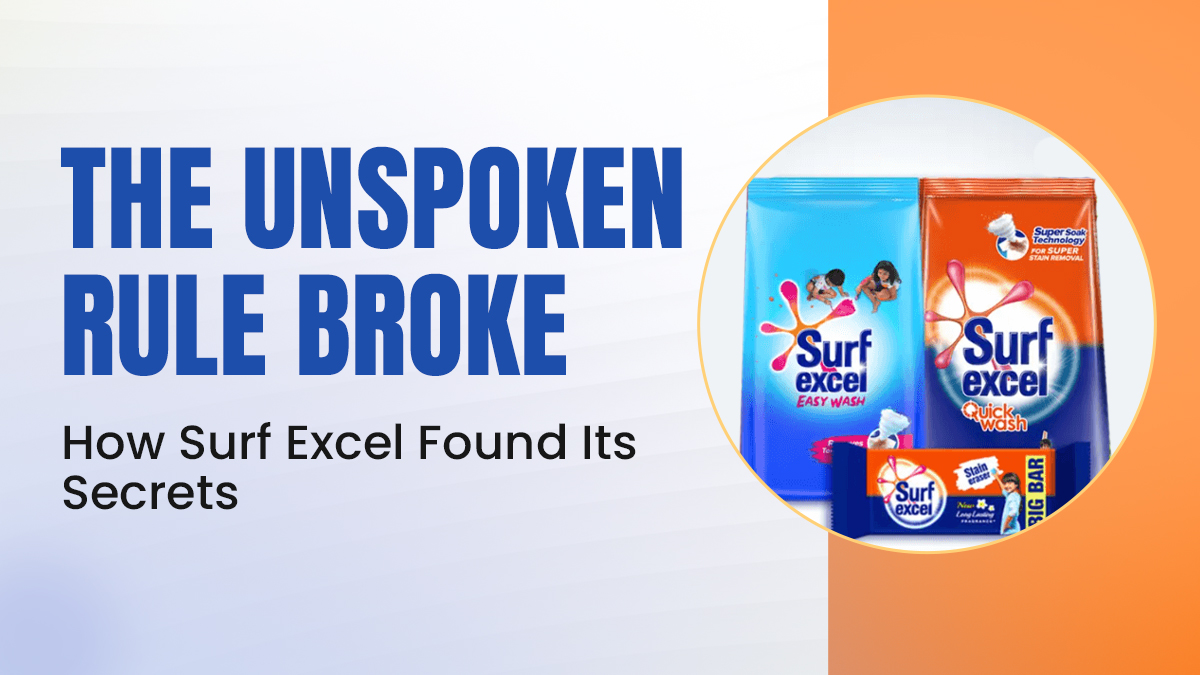
Then there’s a Surf Excel.
They looked at that rule and ignored it. They saw the problem — the stain — and instead of just solving it, they made it the whole point. They didn’t sell more powerful detergent. They sold parents a completely different way of feeling about their kids getting dirty. And that one shift changed everything.
The genius wasn’t in the product. It was in knowing their customers well enough to redefine what the problem was.
The Founder’s Playbook: Building a Brand That Actually Connects
- They flipped the script on the core problem
Every competitor was fighting over whose formula made clothes whiter. Surf Excel was busy convincing parents that some stains deserved to be celebrated.
Their tagline — “Daag Achhe Hain” (Stains Are Good) — wasn’t just a catchy line. The ads showed kids getting filthy, but not out of carelessness. They were helping a friend, sharing a toy, and rescuing a stray animal. The stain on the shirt wasn’t a failure. It was proof that something good had happened.
They stepped out of the commodity war entirely. While every other brand argued over cleaning formulas, Surf Excel was building something no formula could compete with — an emotional relationship. They gave parents’ permission to let their kids explore, make a mess, and actually live — without the anxiety that usually came with it.
The lesson here is worth sitting with a look at the biggest frustration your customers carry about your industry. What’s the unspoken worry underneath it? What assumption has everyone accept without questioning? The brands that flip that assumption — and flip it honestly — are the ones that build real loyalty.
- They became part of the story, not just an ad in the middle of it
Having a powerful message was only the beginning. What came next was smarter — they stopped showing up around cultural moments and started showing up inside them.
During Holi, when colors fly everywhere and clothes are basically collateral damage, they told the story of a young girl protecting her Muslim friend’s clothes so he could make it to prayers. The stain on her own shirt became a symbol of something far bigger than detergent. They did the same during Eid — kids ruining their new clothes while helping a lonely neighbor celebrate. The stains became badges of community.
This wasn’t marketing in the traditional sense. It was a cultural act. By embedding the brand inside moments that actually mattered to people, they stopped selling a product and started standing for something. Competitors couldn’t touch that, because you can’t copy genuine cultural understanding.
The question worth asking for any brand: where do your customers feel most themselves? Not where do they scroll, or what do they watch — but what moments actually matter to them? Find a real, authentic way to show up there and you stop being a brand they buy from and start being one they believe in.
- They used emotion to justify a premium price
This is where it comes together. Surf Excel priced higher than most competitors — and people paid without much resistance.
Not because the detergent was dramatically better. Because the price tag wasn’t really for clean clothes. It was for peace of mind. It was for a brand that understood what parenting actually feels like — the tension between wanting your kid to be free and worrying about every muddy consequence. Paying a little more felt worth it because the brand made parents feel understood.
Once that emotional connection exists, the product stops being a commodity. It becomes the obvious choice, and price becomes a secondary conversation. That’s the real difference between a good brand and one people are genuinely attached to.
“The aim of marketing is to know and understand the customer so well the product or service fits him and sells itself.” — Peter Drucker
The Secret Was Never Really Hidden
It’s tempting to look at Surf Excel and chalk it up to a clever slogan. But that misses the point entirely — like saying a great song is just words in a particular order.
What they actually did was find an emotional problem their customers didn’t know they had and solve it in a way nobody else had thought to try. Parents weren’t just worried about stains. They were worried about being the kind of parent who lets their kid live freely. Surf Excel answered that, not the laundry problem.
People don’t buy products. They buy feelings. Permission to be a better parent. Confidence to be a better friend. A quieter version of the anxiety they carry around every day.
Every industry has a version of that hidden truth sitting underneath the obvious problem. The brands that find it — and speak to it honestly — don’t just build a customer base. They build something people actually care about.
What’s the stain your customers are secretly proud of? Find that, and you’re not just building a brand. You’re building a movement.
