

Estimated reading time: 6 minutes
Can you imagine this? Four young founders are sitting in their small Gurgaon office, sipping homemade Aam Panna that one of them brought from home. They’re playfully arguing over who gets the last sip! Then there is an American teammate, James, who casually asks, “Where can I buy this drink?” Suddenly, everyone goes quiet. For everyone out there, that simple question hits them hard: why aren’t drinks like this available in the market? It is loved in every Indian home.After that moment in 2013, something big was encouraged. It led them to the birth of Paper Boat; it became not just a brand but a journey to bottle India’s most nostalgic drinks. From the kitchen to the store ledge, they didn’t just sell beverages; they shared stories, memories, and traditions, all wrapped in modern packaging.
How Brands Sell Memories, Not Just Products?
Global brands like Coca-Cola and Pepsi are filled with fizzy drinks, expensive ads, and celebrity faces. But they didn’t offer the taste of Grandma’s homemade summer drinks or that warm kulhar chai from a train station.
Young consumers were getting smarter. They were reading labels, avoiding excess sugar, and looking for clean, local ingredients. Paper Boat found its sweet spot—where tradition met modern life. It didn’t just sell beverages; it offered something special: “Drinks and Memories”. That one line became their guiding light for everything from marketing to flavours to future products.
Strategic Pillars of Success
1. Product Philosophy: Making Memories Drinkable
- The flavour selection process is focused on some of India’s old collective memory banks, like Aam Panna, Jaljeera, Kokum, Aamras, Sattu, and Rose Sherbet, and so many more.
- Recipes were made without adding any chemical preservatives, while staying true to original flavours.
- Every ingredient was imported, like raw mango from Gujarat, tamarind from Andhra, and kokum from Konkan, while respecting customers’ balance around taste and their health.
2. Emotional Positioning Over Functional Benefits
Paper Boat never talked about vitamins or electrolytes. Instead, ads invited viewers to “float back in time”, giving the option of nostalgia, comfort and joy, three feelings the opponent ignored. Emotional harmony became a protective ditch difficult for function-led brands to bridge.
3. Innovation in Packaging Design
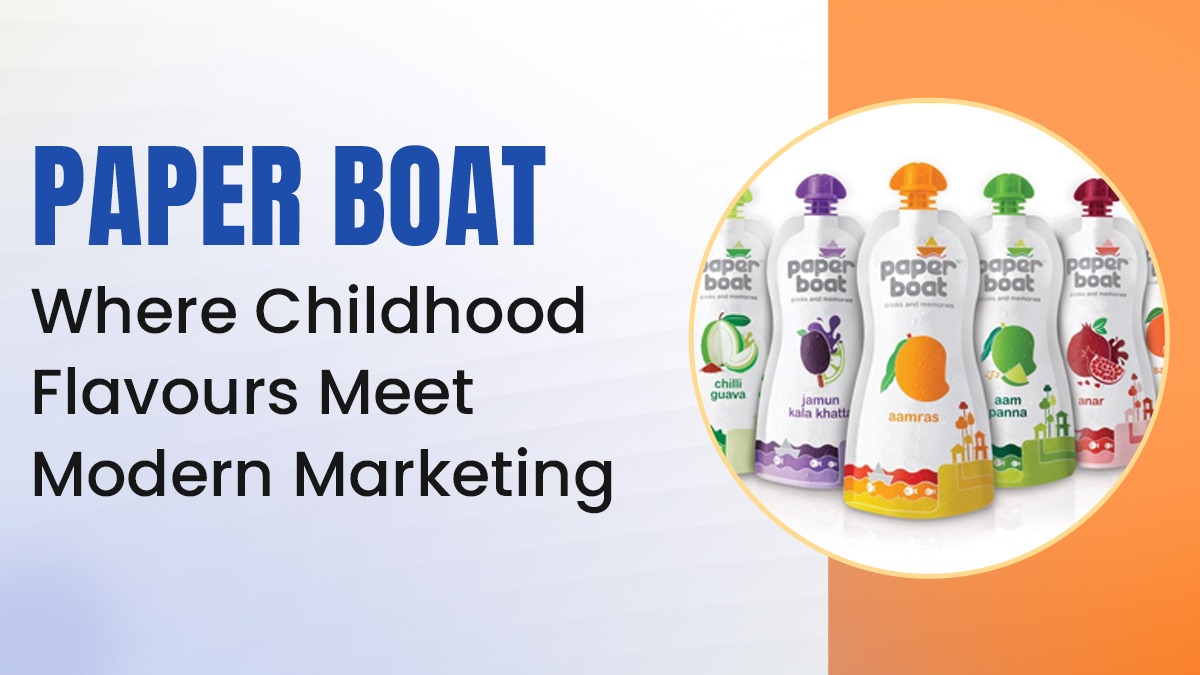
The pear-shaped pouch of Paper Boat becomes attractive. It was ergonomic, cold in seconds and glaringly obvious, not just a gimmick but immaculately contoured to remind you of paper boats navigating the streets during monsoons; it was as much for good design as happy reminiscence.
The Nostalgia Marketing Playbook
- Bhav Bhagwa – Farmers are seen starting their day and harvesting raw mangoes early in the morning, or coconuts being dried on yard baskets, epitomising the sourcing ethos as well as the product story about food.
- Nook Childhood Chronicles – Ads show comics rolled into back pockets, spinning tops on dusty verandas and school-bus window games. Every moment is seamlessly connected with the beginning of a flavour, making each impression slightly less impersonal.
- Local Love — Launches region-specific to celebrate our rich linguistic diversity: Tughlaqi Shikanji for Delhi summers, Panakam for Tamil New Year, and Sattu for Bihar’s heat waves. This micro-segmentation
Differentiation in a Crowded Market
Against International Giants
Global brands rely on formulaic marketing campaigns, event tie-ins and sports stars. Paper Boat counters with soft power: poetry on the pack, folk tunes in videos, local farmers as heroes. It competes on emotion, locality and ritual rather than price or carbonation.
Beyond Surface-Level Nostalgia
While some advertisers flash 1990s toys for cheap sentiment, Paper Boat roots nostalgia in sensory recall—the tang of raw mango, the chilli-salt pinch on lips, the pink stain of jamun on school uniforms. Such specificity is hard to mimic and cements brand loyalty.
Strategic Business Decisions
- Taste of Tradition – Mini-films show that real farmers are picking raw mangoes or drying kokum, while highlighting honest sourcing and quality ingredients.
- Childhood Moments – you know what ads bring back memories of revolving tops, comic books and bus rides and each one is tied to the story behind a drink’s flavour.
- Local Favourites – these are some regional drinks like Sattu in Bihar or Panakam in Tamil Nadu, which celebrate local tastes and festivals to make the brand more engaged.
- Honest Ingredients – Clear, simple labels build trust. No hidden chemicals—just real ingredients, making it a healthier choice over regular sodas.
Challenges and Course Corrections
Paper Boat briefly launched peanut chikki and alphabet-shaped cereal to capture snack occasions. The line extension diluted its beverage purity, confused shelf placement and sapped manufacturing focus. Management swiftly killed the experiment, proving discipline is as vital as creativity. Another test—the glass-bottle premium series-found favour in cafés but increased breakage in general trade. Lessons fuel better SKUs, not brand drift.
Scaling authenticity also meant resolving tension between artisanal perception and industrial throughput. New aseptic lines were needed to triple capacity without altering flavour. The solution: micro-batch recipe testing in an R&D kitchen that mirrors household cooking, then scaled via proprietary pasteurisation. Quality audits across ten checkpoints guarantee no batch leaves without the signature “home-style cloudiness”.
Competitive Advantage Framework
- Emotional Differentiation – Memories are a moor that algorithms can’t replicate.
- Cultural Insight Mining – Founders’ lived experience provides nuance that armies of consultants miss.
- Consistent Brand Experience – Tone, typography and even cap colours reinforce the same core story, compounding recall year after year.
Strategic Learnings for Entrepreneurs
- Find Emotional White Space – Chart your category’s feelings map; win where others don’t play.
- Cultural Depth Beats Surface Trendspotting – Immerse, don’t just observe.
- Guardrails Matter – Not every adjacent aisle belongs to you; protect the centre.
- Local Wisdom, Modern Execution – Pair grandmother’s recipe with modern packaging and cold-chain logistics.
- Emotion Scales Are Cheaper Than Function – Heartstrings require fewer rupees per GRP than celebrity bursts.
The Road Ahead: Sustaining Nostalgic Appeal
Paper Boat is now looking to reach ledges in the Middle East and Southeast Asia as well, where people used to miss the familiar tastes of home. Their motive and global plan is to include eco-friendly packaging of their product in carbon-neutral factories and smart tech that ensures the reduction of waste. But you know what? Their heart stays the same. This confirms that they’re not just selling drinks; they’re offering long-lasting memories, like when evening games ended and your mom called you home from the balcony to drink something.
In a world chasing the next big thing, sometimes the real magic lies in bringing back what we already hold close, our memories.
