

Estimated reading time: 7 minutes
Everybody sees Swiggy now—a food delivery giant, a household name. But cast your mind back a decade. Back then, countless startups were throwing money at the problem and going nowhere. Yet, this one company cracked a different kind of code, scaling to over 580 cities in India. The surprising part? Their runaway success wasn’t built on groundbreaking technology or a bottomless wallet. It was pure, old-school strategic thinking—a deep understanding of human psychology.
Think about this: India’s biggest food empire wasn’t built by food connoisseurs. It was built by people who knew human behavior inside and out. They figured out what customers truly wanted, sometimes even before the customers themselves did.
The Real Swiggy Formula (And Why It’s Not What You Think)
Let’s get one thing straight: Swiggy never published a “5 Growth Hacks” manual. Here is our own breakdown of their strategic journey since 2014, pieced together from their evolution from a small Bengaluru startup to the giant it is today. This whole customer-centric revolution was spearheaded by founders Sriharsha Majety, Nandan Reddy, and Rahul Jaimini. The idea was simple: build a tech-powered platform that delivered unparalleled customer value.
While a competitor like Zomato was focused on being a restaurant’s discovery and review site, Swiggy’s true genius was in its sheer execution. They turned online food ordering into a rock-solid promise of reliability, and that single-handedly transformed the customer experience in India’s incredibly complex food market.
It Started Hyperlocal: The Neighborhood-First Strategy
Customer loyalty begins right at your doorstep, not in some national trend report. Swiggy’s first brilliant move was recognizing that food delivery isn’t one big national business; it’s thousands of tiny, neighborhood-specific businesses. Their plan was straightforward: get a foothold in the big cities, then hit Tier 2 and Tier 3 cities hard with incredibly targeted, local marketing.
But they had a problem. What about a neighborhood where demand was high, but there just weren’t enough good restaurants? Most people would walk away from that. Swiggy decided to solve it. Their Swiggy Access cloud kitchens were the answer. They bypassed the supply-side problem completely—you can’t deliver what doesn’t exist locally. Their technology was smart enough to onboard new kitchens based on real-time demand data, literally creating new food options out of thin air.
The lesson here for founders is: Solve the local problem before you go national. Swiggy’s success wasn’t about a grand vision; it was about fixing a real, on-the-ground constraint first. Your customer’s experience has to be tailored to their street, not just their country.
Your Delivery Fleet is Your Competitive Moat
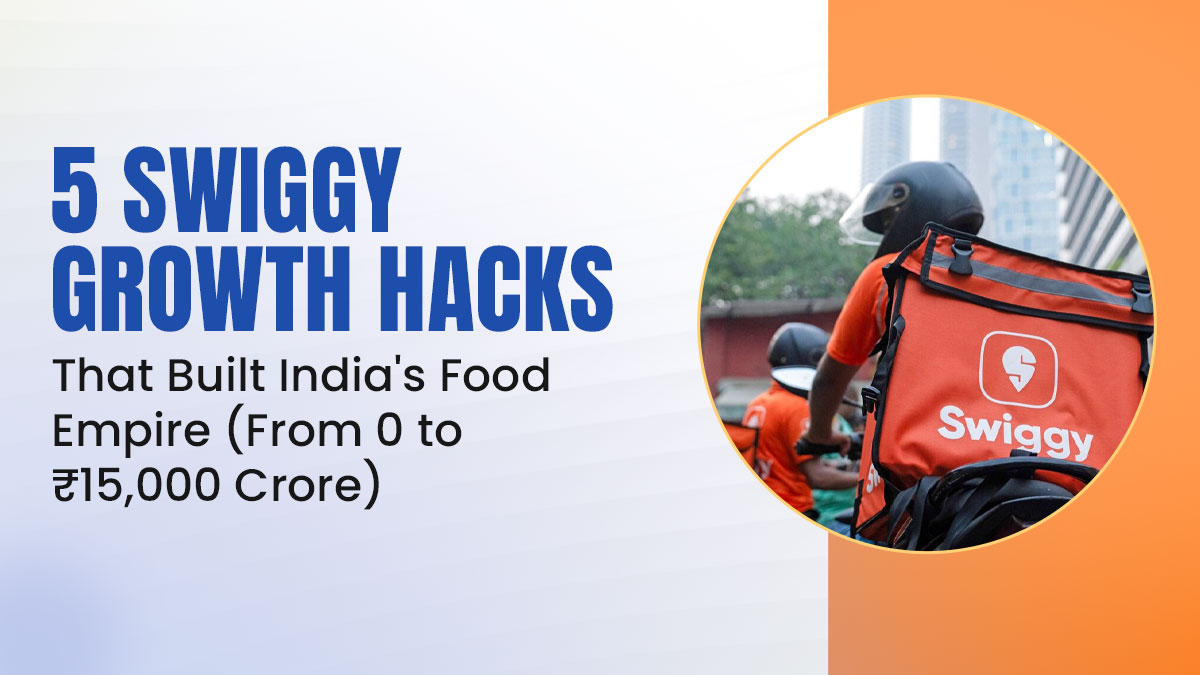
When you order food, what matters most? It’s not the menu. It’s the predictability of getting your order on time. While everyone else treated delivery as an afterthought, Swiggy built its logistics network as its central core. With a fleet of over 2.5 lakh delivery partners, their platform promises a consistent, safe, and on-time delivery every single time. Every single one of their delivery partners is trained, gets a peak-hour bonus, and uses an algorithm that helps them avoid traffic.
The real innovation is in the tech behind the scenes. There’s live GPS tracking for transparency, dynamic assignment to make sure delivery partners can pick up multiple nearby orders efficiently, and cold-chain logistics for groceries and frozen items. In major cities, their Swiggy Pods (operational hubs) help batch-pack orders, and their AI predicts demand to optimize delivery routes.
That’s the real insight for business owners: A loyal customer isn’t built on choice; they’re built on reliability. Swiggy figured out that a predictable 30-minute delivery creates a far stronger brand connection than having 10,000 restaurant options with shaky timing.
Data Doesn’t Lie, It Personalizes
Engagement skyrockets when a platform knows what you want before you do. Swiggy’s marketing moved past generic promotions and into the realm of hyper-personalized experiences. Their platform doesn’t just collect data; it uses it to get to know you. The app analyzes what you order, where you are, what time of day you order, and your budget to create a feed that feels like it was made just for you.
The tech integration is what makes it work. You get personalized offers and dynamic pricing, recommendations that highlight dishes based on your past orders, and even cross-promotional banners for other Swiggy services like Instamart. Their latest trick is pre-customized carts with two items each—a simple way to eliminate decision fatigue when you’re at your hungriest.
Here’s the takeaway for entrepreneurs: The Swiggy One loyalty program is a masterclass in this. It’s a subscription model that not only keeps customers coming back but also provides an endless stream of valuable behavioral data for even deeper personalization.
The Ecosystem Play: From Food to Total Convenience
Swiggy could have stayed a food delivery app. Most companies in their position would have. Instead, they looked at what they already had, a massive customer base, an established delivery network, a brand people trusted, and asked what else they could do with it.
Swiggy Instamart was the answer to that question. Quick commerce, groceries, household essentials, restaurant reservations. Suddenly they weren’t competing just with other food apps. They were going head to head with Dunzo, Zepto, and anyone else playing in the convenience space.
The smart part wasn’t the expansion itself. It was how they did it. They didn’t need to rebuild trust from scratch in each new category because the trust was already there. Customers who relied on Swiggy for dinner were willing to try Swiggy for groceries. One app handling everything means customers have little reason to go anywhere else, and that’s exactly the point.
For founders, the takeaway is practical: your existing customer relationships and infrastructure are assets that extend beyond your original product. A single-service competitor can’t easily replicate an ecosystem built on years of trust and habit.
Community: Turning Customers into Brand Evangelists
Swiggy figured out something most brands still haven’t: if customers feel like they’re part of the story, they’ll tell it for you.
Their “Why Is This a Swiggy Ad?” campaign is a good example. It was deliberately puzzling, asking users to decode theories for prizes, and it generated the kind of conversation no paid media budget reliably produces. People were talking about it because they wanted to, not because they were asked to.
Their Instagram and Twitter presence works the same way. Humorous, shareable, built around content that feels like it comes from a person rather than a marketing department. Memes, user-generated content, campaigns that invite participation rather than just viewership. The audience doesn’t feel marketed at. They feel included.
That distinction matters more than most founders give it credit for. Your customers can carry your brand further than any ad campaign, but only if you give them something worth carrying.
The Uncomfortable Truth About Building Sustainable Growth
How does a company maintain a human focus while scaling across 580 cities and millions of orders? It’s simple, really. They balance a technology-powered standardization with local, human customization. Swiggy’s leadership comes from solving the hard, messy operational challenges that others just don’t want to touch—things like supply chain management, delivery partner training, and real-time demand prediction.
Swiggy’s transformation proves one final point: Technology alone won’t create loyal customers. Consistently solving real, messy human problems will.
“Your most unhappy customers are your greatest source of learning.” — Bill Gates
FAQs
- What helped Swiggy scale faster?
Strong local execution and logistics.
- Why do customers trust Swiggy?
Consistent and timely deliveries.
- What is Swiggy One?
A loyalty and subscription program.
- Did Swiggy rely only on technology?
No, it focused on solving real customer problems.
